History
Perched on a high bluff overlooking the Chowan River, Winton is one of the oldest communities in northeastern North Carolina and has served as the seat of Hertford County government for more than 250 years. Long before European settlement, the region was home to Native American tribes including the Meherrin, Chowanoke, and Tuscarora peoples, whose presence shaped the area’s early history and trade routes. The Chowan River made the location strategically important for commerce, transportation, and fishing for centuries.
The community began in the 1740s as “Cotton’s Ferry,” named after Alexander Cotton, who operated a ferry crossing on the Chowan River. When Hertford County was established in 1759, the area quickly became an important governmental center. In the mid-1760s, landowner and legislator Benjamin Wynns donated acreage for the development of a permanent town, originally called “Wynnton” or “Wynntown.” The town was officially incorporated in 1768 and soon became the county seat, a role it still holds today. During the colonial era, Winton functioned as a Royal Port of Entry and later served as a staging and supply point during the American Revolution.
Winton’s most defining historical moment occurred during the Civil War. In February 1862, Union troops entered the town following a Confederate ambush along the Chowan River. In retaliation, Federal forces burned nearly every building in Winton, including the courthouse, making it the first North Carolina town destroyed by Union troops during the war. Much of the town’s early architecture and many county records were lost in the fire. Despite the devastation, residents slowly rebuilt after the war, constructing a new courthouse in 1870 and restoring Winton as the center of county government.
During the late nineteenth and early twentieth centuries, Winton experienced renewed growth driven by agriculture, lumber, fishing, and river commerce. The town became a regional trading center for crops such as cotton, corn, and peanuts. Important transportation improvements—including the Winton-Ahoskie Highway and the first bridge across the Chowan River in 1925—helped strengthen commerce and connectivity throughout Hertford County.
Winton also holds an important place in African American educational history. In 1886, educator and minister Calvin Scott Brown founded Chowan Academy for African American students, later known as the C. S. Brown School. It became one of the most significant educational institutions for Black students in the region and remained the county’s only high school for African Americans until 1937.
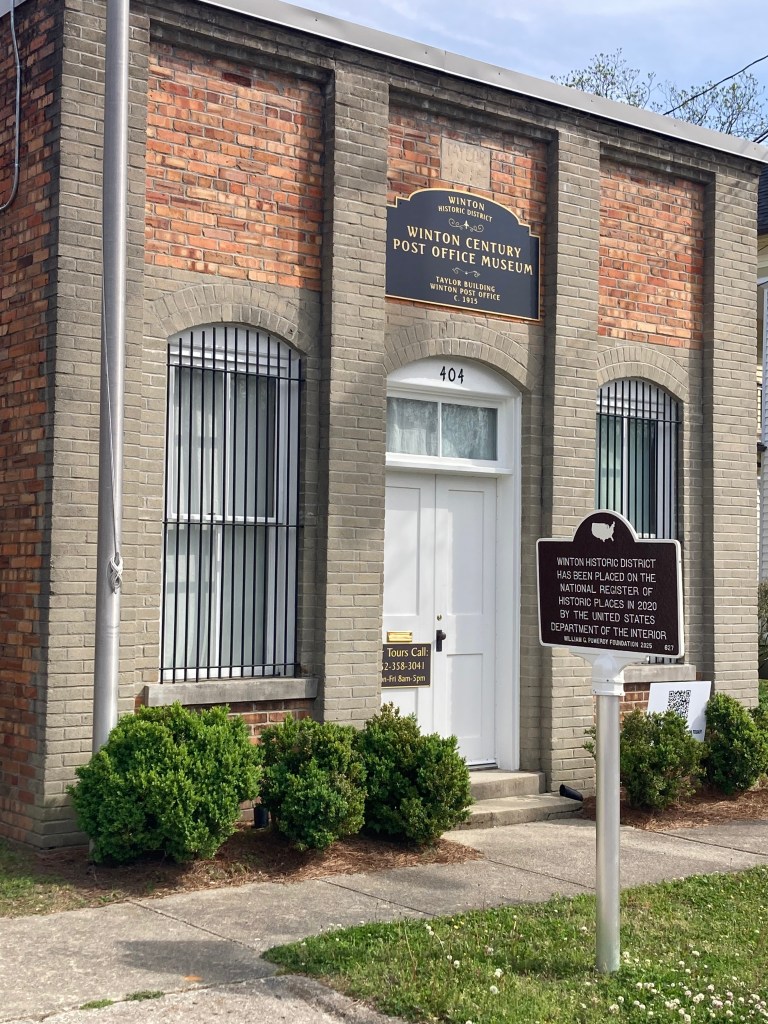
Today, Winton’s historic character is preserved through the Winton Historic District, which was added to the National Register of Historic Places in 2020. Many surviving buildings reflect architectural styles popular after the Civil War, including Italianate, Queen Anne, Colonial Revival, Craftsman, and Gothic Revival influences. Though the town’s economy and population declined after highway bypass construction in the 1970s shifted traffic away from downtown, Winton remains a community deeply connected to its river heritage, historic courthouse square, and long legacy as one of North Carolina’s earliest colonial towns.
Winton has a citizen run historical association that operates a history center on main street as well as maintain the history of the city. We would love for you to be involved in this effort. Please contact us at wintonhistoricalassociation@gmail.com. Were also on Facebook – search for us at WintonHA!